Games · Early test build
Dear Fridge,
A relaxing poetry game: you're dealt word magnets, you make a short poem on a fridge door, and the Fridge reads it back and scores every rhyme and image it finds.
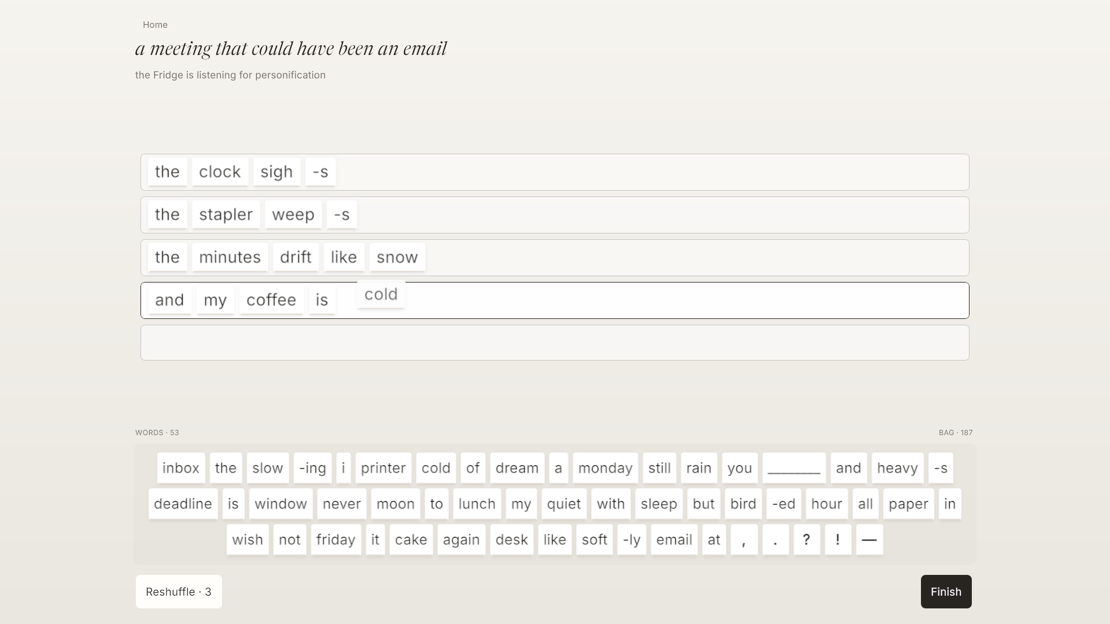
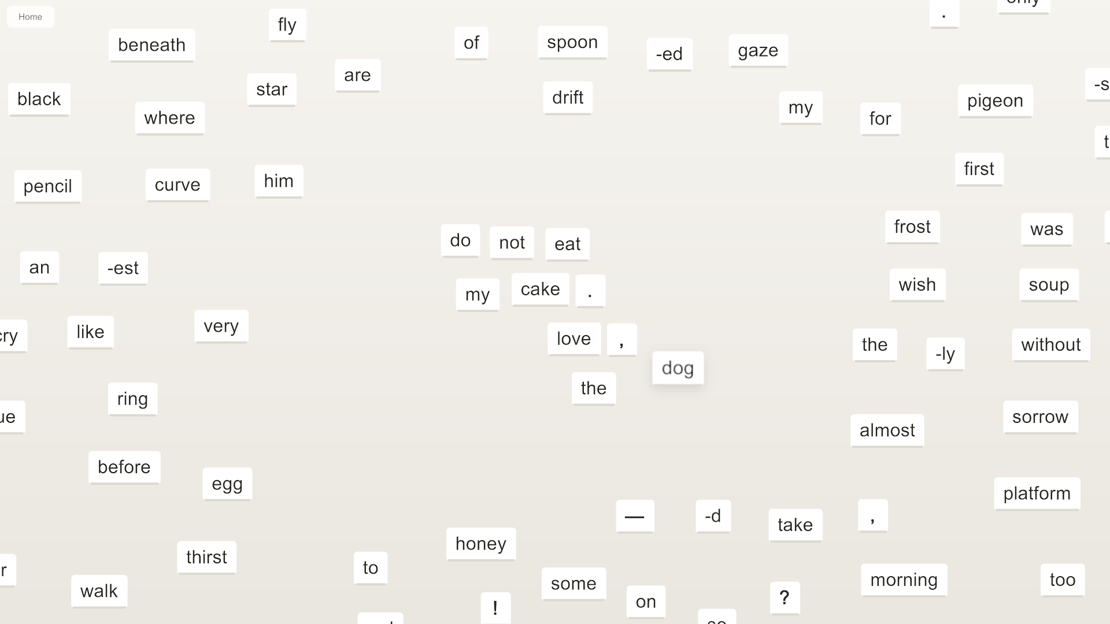
I have never once walked past a fridge covered in word magnets without stopping to rearrange them. Dear Fridge, is that habit made into a game. The comma is part of the name: every poem is a note to the Fridge, and the reveal is its reply. You’re dealt a tray of word magnets, you push a few of them into a short poem on an off-white fridge door, and when you press Finish the Fridge reads what you wrote and replies.
You can’t say what you mean
That’s the whole trick. With fifty-odd magnets in the tray you almost never have the word you wanted, so you go looking for the one you can use instead, and the poem comes out stranger than the one you had in mind. Usually better, too. Poems are short, two to five lines, and nothing hurries you: no timer, no lives, no streak to keep alive, no score ticking while you work. If a tray is hopeless you throw the whole thing out and draw a fresh one, three times a round, and the fresh one is dealt by the same rules as the first, so it still has its small words.
Those small words took me longer to notice than I’d like to admit. When I finally counted, 34 of the hundred most common words in English weren’t in any pack. There was no “have”, “what”, “about” or “would”, so nobody could write “would you stay?”, and in a game called Dear Fridge, you couldn’t write “dear”. The starter kit has most of them now, and punctuation too. Every tray gets a comma, a full stop, a question mark, an exclamation mark and a dash. A mark sticks to the word beside it and can never cost you a point. It only pays when it does a job a reader would notice: the comma in “oh moon, you are cold”, a real question, a full stop halfway along a line, or a dash held like a breath just before the poem turns.
The Fridge replies
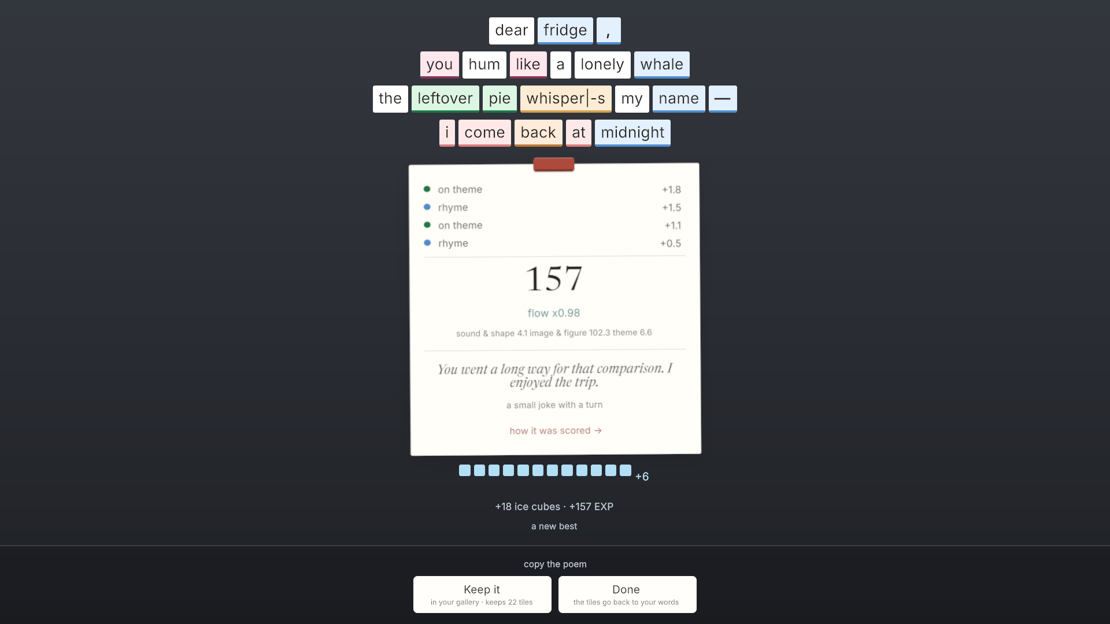
The reveal is the part I fuss over most. The light dims, the poem stays lit, and the Fridge goes through it line by line, lighting up every rhyme, alliteration, simile and turn it can find, each in its own colour. The points tally up, a Flow multiplier lands last for how plausibly each word follows the one before it, ice cubes drop, and the Fridge writes one dry line on a paper note about the thing it liked best. Then it names the poem: “an image poem”, “songlike”, “a small joke with a turn”. This one, from the screenshots below, scored 157 and was filed under “a small joke with a turn”:
dear fridge,
you hum like a lonely whale
the leftover pie whispers my name —
i come back at midnight
The Fridge wrote back: “You went a long way for that comparison. I enjoyed the trip.”
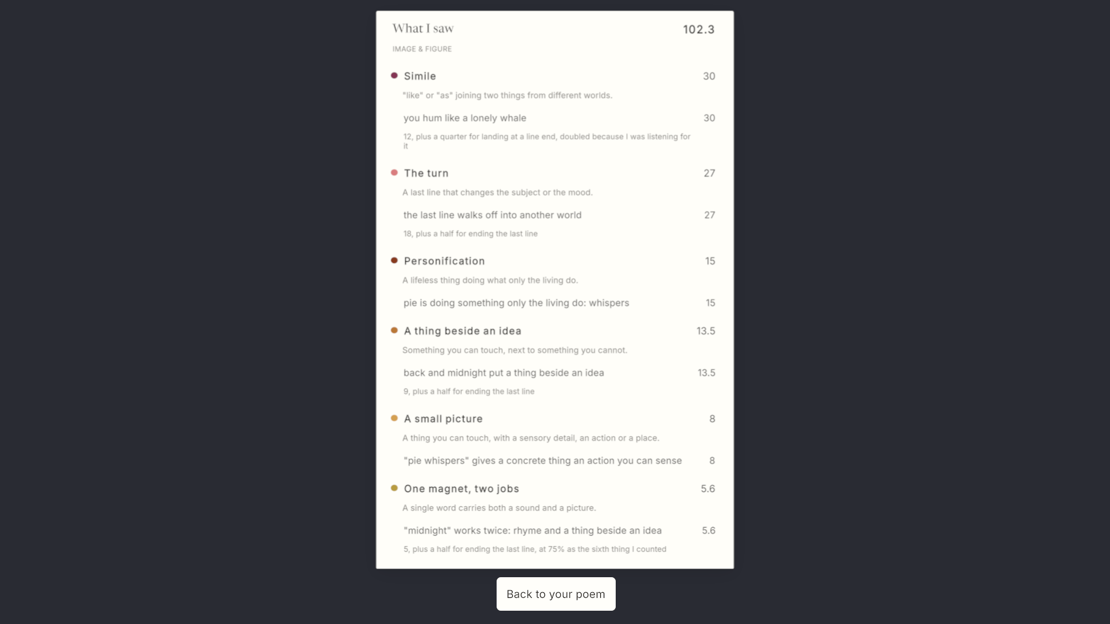
The Fridge is not clever, just thorough. The scoring is a set of plain rules with no machine learning anywhere in it, and every rule can be explained: tap “how it was scored” and you get a sheet of paper going through the score in the Fridge’s own words, finding by finding. Its attention runs out, too. The first five things it finds pay in full and each one after that counts for less than the one before, so a poem stuffed with tricks doesn’t run away with the score. The same poem on the same card always scores the same, and every scoring exploit I stumble on becomes a test. There are twenty-eight techniques now, from rhyme and personification to odder ones with plain names like “a word handed on” and “both hands full” (anadiplosis and zeugma, if you want the proper words), and each has a page in a rulebook that only fills in once the Fridge has caught you doing it.
The colours got a pass of their own just before the build went out. Sound techniques are cool colours and image techniques warm ones, and the ones that tend to turn up in the same poem differ in lightness as well, since lightness is what a colour-blind eye keeps.
Ice cubes, packs and blanks
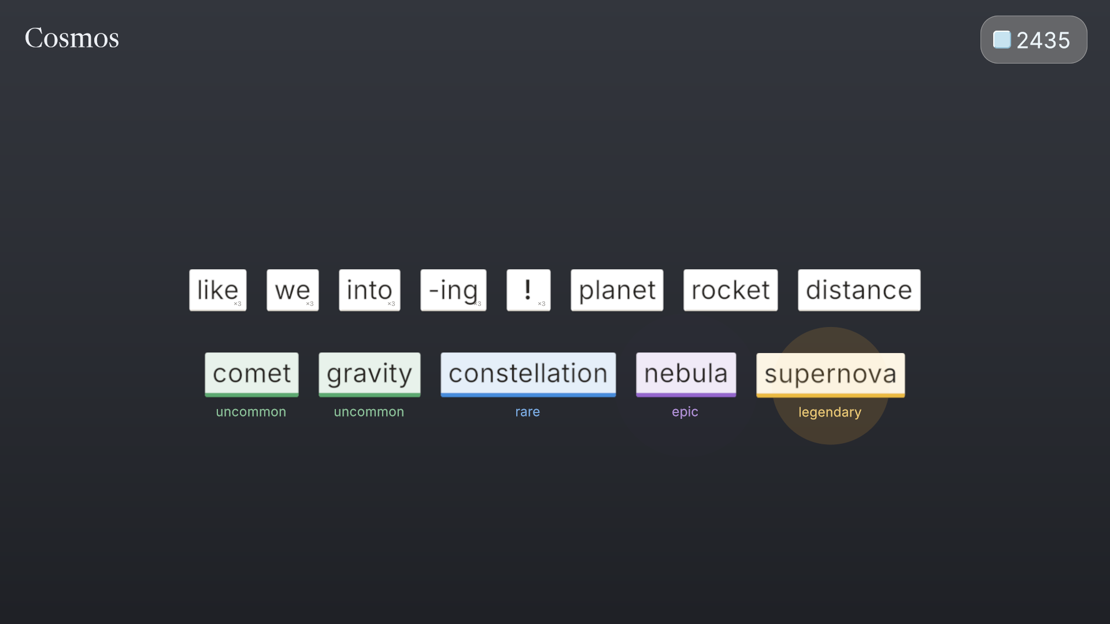
Ice cubes are the currency. They buy sealed packs of new words, opened in a small ceremony where the sleeve drops in, shakes and tears. Besides the starter kit there are eight themed packs: Sea, Office, Kitchen, Cosmos, Garden, City, Love and Fairytale. That’s about 1,300 magnets in all, commas and full stops included, and every word is tagged so the Fridge knows what it’s looking at. A themed pack costs about a day of honest play, and its new words turn up in your next few trays. Now and then a pack carries a blank magnet. You write a word on it when you lay it down, and it wipes clean when you take it off again, unless you keep the poem, which writes it on for good. There is nothing to buy with real money.
Where it stands
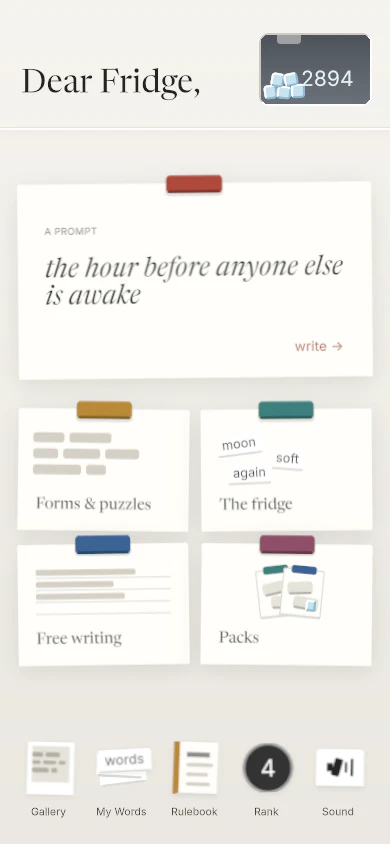
The first test build went up on itch.io on 24 September, and it plays in the browser. The whole loop is in it:
- prompted rounds, and a Daily that is the same card for everyone and needs no server
- forms that open up as your rank climbs (haiku, couplet, quatrain, cinquain, limerick), and puzzle boards with a rule or two
- a free-writing card for typing a poem instead of building one (scored, but no cubes)
- the free fridge, where all your words hang and you shove them around
- a gallery of kept poems, with your Dailies on a calendar
- ranks from “World’s Okayest Poet” up to “Fridge Laureate”
Saves live in the browser and should survive updates. At the back of the rulebook are the credits and a form for telling me where the Fridge misread you. What I most want to find out is whether people come back the next day for the Daily. If they do, Android is next.